
Some links are affiliate links, which means I may earn a small commission if you choose to follow them—at no extra cost to you. It helps keep Growls & Grimm running.
As an Amazon Associate, I earn from qualifying purchases.
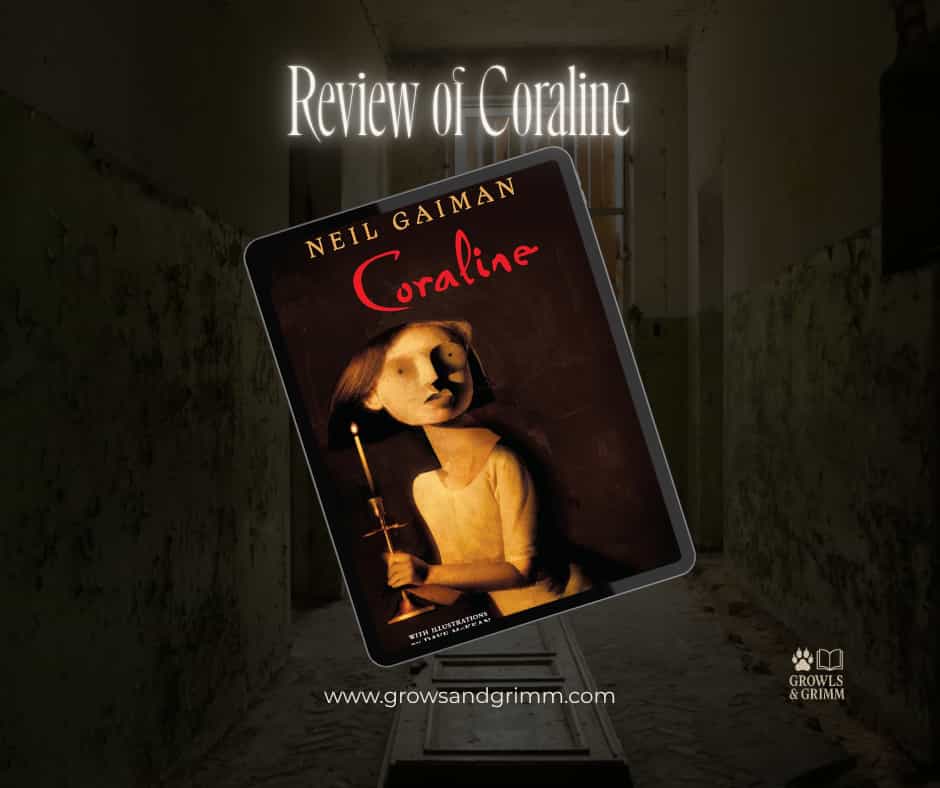
Review of Coraline by Neil Gaiman
Dark Fantasy | Horror | Fiction | Young Adult
“The names are the first things to go, after the breath has gone, and the beating of the heart. We keep our memories longer than our names.”
Coraline understands children’s horror the way old folklore understands children’s horror.
The danger isn’t simply something lurking in the woods or an obvious monster waiting to be defeated. There are rules to understand, choices to make, and frightening things a child is simply expected to face.
Neil Gaiman’s writing is deceptively simple, but that simplicity makes the growing wrongness of the Other World even more effective. Nothing needs to be described in elaborate detail to become unsettling. The deeper Coraline goes, the clearer it becomes that this familiar-looking place is anything but safe.
And getting out is only part of the problem.
Is Coraline scary for younger readers?
Yes, Coraline can be frightening for younger readers, although its horror is more unsettling than graphic. The story uses creepy imagery, touches of body horror, and a persistent sense that something is wrong. Whether it is appropriate for a particular child depends less on age alone and more on what that reader finds frightening.
Old Folklore in a Children’s Story
There is something about Coraline that feels less like a modern children’s story and more like the old folklore where children wandered into dangerous places and were expected to be clever enough to find their own way back.
Coraline isn’t given a complicated set of powers or an adult who arrives to fix everything for her. She has to pay attention. She has to understand the rules of the Other World, recognize when something isn’t what it appears to be, and make choices while being genuinely frightened.
The simple prose works particularly well here. It doesn’t soften what is happening or spend much time explaining how the reader should feel about it. Something is wrong. Coraline knows something is wrong. Now she has to figure out what to do about it.
Her bravery isn’t the absence of fear. It is her willingness to keep going while knowing exactly how frightening the situation has become.
The Horror You Have to Touch
There is something about Coraline that feels less like a modern children’s story and more like the old folklore where children wandered into dangerous places and were expected to be clever enough to find their own way back.
Coraline isn’t given a complicated set of powers or an adult who arrives to fix everything for her. She has to pay attention. She has to understand the rules of the Other World, recognize when something isn’t what it appears to be, and make choices while being genuinely frightened.
The simple prose works particularly well here. It doesn’t soften what is happening or spend much time explaining how the reader should feel about it. Something is wrong. Coraline knows something is wrong. Now she has to figure out what to do about it.
Her bravery isn’t the absence of fear. It is her willingness to keep going while knowing exactly how frightening the situation has become.
The Horror You Have to Touch
Some of the most effective horror in Coraline isn’t simply something she sees.
She has to touch it.
The lost souls are hidden inside marbles that Coraline has to find. At one point, that means reaching into something resembling a spider’s egg sac. The Other Father eventually becomes something almost dough-like in the basement. There are buttons where eyes should be and a remaining button that has to be physically removed.
The imagery isn’t particularly graphic, but it doesn’t need to be. Gaiman makes the horror tactile.
These aren’t monsters safely observed from across the room. Coraline has to put her hands into the strange and unpleasant parts of the Other World if she wants to escape it.
That makes her bravery feel physical. She can’t simply understand what needs to happen. She has to make herself do it.
When the Dark Follows You Home
Closing the door should be the end. It isn’t.
The Other Mother’s severed hand makes it through into Coraline’s world, still searching for the key that could reopen the passage between them. Escaping the Other World hasn’t removed the threat. It has simply changed where the confrontation happens.
And I think this is where Coraline becomes particularly interesting.
The first time, she is trying to escape. Now she understands what she’s dealing with. Instead of waiting for the Other Mother to find another way back, Coraline makes a plan to end the threat herself.
The danger followed her home. This time, she is ready for it.
The dream picnic with the children whose souls Coraline freed gives the ending more emotional weight than simply defeating the Other Mother and going back to normal.
Those children were trapped long before Coraline arrived. She doesn’t just save herself and her parents; she finishes something that began before she ever opened the little door.
And then life continues.
That combination works particularly well for Coraline. The strange world doesn’t need to become less strange, and Coraline doesn’t need to become fearless. She has simply learned that frightening things can be faced.
Coraline may be written for younger readers, but I wouldn’t mistake that for meaning it isn’t frightening. The horror is vivid without being particularly graphic, relying instead on unsettling imagery, touches of body horror, and the persistent feeling that something is wrong.
For younger readers especially, this is one where knowing what frightens your particular reader matters more to me than the recommended age printed on the cover.
If this story stayed with you, these reads belong on your shelf → Dark Books Where Something is Wrong with the House
Track your reading journey here → T.B.R. Tracker
If you’re building your next reading stack, you can follow along with everything I’m reading (and what’s actually worth it) here:
→ Goodreads + StoryGraph
And if you want to wander the shelves a little longer, the seasonal reading rooms and themed stacks live here:
→ Pinterest